Friday, July 19, 2013

Precious Stones

I take slow, deliberate steps along the shore of Lake Superior with my head cast down, gaze sweeping methodically across the ground. Thousands of small pebbles are scattered in tiers on the sand, some glistening at the edge of the ebbing waves, others pushed further up the beach by past storms. They create a colorful earth toned mosaic punctuated by bright flecks of mustard, terracotta and slate blue.

My eye is most easily drawn to the layered nuggets of maroon and gray, which glow like hot embers in the shallow water. These rocks known as banded iron formations were created in the region two billion years ago when oxygen first became abundant in the atmosphere. This element combined with dissolved iron in the oceans to form iron oxides. The oxygen was produced by photosynthesizing algae, thus preserving the first breath of plant life in stone and laying the future economic foundation of this entire region.


I spy an oval shaped slip of white rock scored with telltale tubular striations contrasting against the grainy brown sand. It is a piece of fossilized coral from the ancient shallow sea that covered this land 400 million years ago. I imagine a watery world blanketed with coral reefs. Sea lilies sway in the current as the perfectly spiraled shell of an ammonite jets by, squid-like tentacles streaming in its wake. Trilobites scuttle across the sea floor over and around clusters of brachiopod shells. A seagull’s call brings me back to the terrestrial present, but thoughts of geologic time and transformation continue to swirl in my mind.


I am determined to collect a rainbow of rocks. Oranges and blues are mostly igneous rhyolite and basalt deposits from a 1,200 mile long rift through the heart of North America that opened up one billion years ago. It extended from modern day Ontario down to Kansas and branched over into Michigan. A large basin formed at the junction of the northern and eastern arms of the rift, which was ultimately filled with water by retreating glaciers to form Lake Superior just 10,000 years ago. I add them to the metamorphic green epidote and yellow chert already in my pocket.


Red, brown, purple and white sandstones represent deposits from ancient rivers and streams that flowed off the volcanic mountain ranges in the region 500 million years ago. The brown sandstone was particularly prized by architects in the late 1800’s as a building material, referred to as Lake Superior Brownstone, and was used to construct many stoic buildings and residences in the towns that ring the lake. These sandstone formations were also carved and smoothed by wind and waves to form the Apostle Islands.


The individual colors of rock all blend to steely gray as twilight approaches. I sit on the beach listening to the hush of the waves lapping onto shore, holding the accumulation of two billion years in the palm of my hand. Sunset casts its glow as the lights of Washburn begin to twinkle in the distance. I dig my toes down into a confetti of geologic time to feel the lingering warmth of the radiant summer sun still in its grains.


Friday, June 7, 2013

History and Memory at the Santa Barbara Mission

The city of Santa Barbara is stunningly situated along a crescent shaped bay that slopes gently from the shoreline up into the Santa Ynez mountains. The seemingly infinite ocean view is tempered by the sight of the Channel Islands rising out of a haze of distant saltwater spray. A tapestry of whitewashed stucco and terracotta clay tile blankets the rolling green hills, in deference to the Spanish colonials who settled here in the late 1700's. My parents had come from the cold and snowy Midwest to visit Southern California, and sun drenched Santa Barbara seemed like the perfect place for a day trip. We decided to visit the Mission to gain a better understanding of the complex history of this area, which was shaped by successive waves of Native, Spanish, Mexican and American influence.

Spanish missionaries were likely amazed by the similarities in geography and climate to their native homeland when they first arrived in California. The architectural style and agricultural crops that had evolved over centuries in Spain were easily grafted onto the California coastal landscape. Even today, a visit to the Mission feels like an instantaneous trip to another place and time. The four of us stepped across the foyer threshold into their Mediterranean world and quietly ambled down the long shady walkway skirting a courtyard garden filled with citrus, palm trees and herbs. An alter of offertory candles flickered warmly in the dim light of an adjoining portico. We admired the craftsmanship evident in the surrounding decorative iron and wood work, and marveled at the ornately painted interior of the church sanctuary. A high arched door led out into the cemetery, where sunlight cast a network of shadows onto the lawn as it passed through the outstretched branches of a gnarled fig tree. I glanced back at the moss covered exterior of the shaded church walls and saw above the doorway a faded arc of skulls and crossbones embossed in the stones.
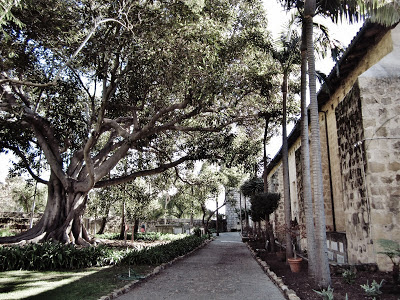

Across the lawn, the long cool stone walls of the mausoleum interior were lined by polished marble plaques etched with names and titles of important clergy members and prominent citizens who contributed to the success of the mission settlement. I continued strolling the grounds reading the Spanish surnames carved into the tombstones and sarcophagi, each one blending together with the next to form a manifest of faith and devotion. I thought of all the generations of families who have taken comfort from visiting their loved ones in this place and was unsettled by the growing awareness that I was a complete stranger surrounded by two hundred years and many lifetimes worth of memories and experiences that were wholly unknown to me.  

And then I saw it. A bronze plaque on the wall in a distant corner of the yard, different from all the rest with its industrial appearance and modern font. I walked over to read what it said and felt my breath catch in my throat.


I knew this story like it was my own. A young woman was accidentally separated from her people during the chaotic evacuation of their island home far off the coast of California. She lived alone on the island for almost two decades learning how to hunt and fish, and to protect herself from predators. A fictional account of her life was published in 1960 by Scott O'Dell, entitled Island of the Blue Dolphins. From the few shreds of her known history, he wove a story that swept me up in the tragedy and beauty of her solitary existence. She was the idol of my childhood, this strong, resourceful woman who developed the skills to survive in such an unforgiving environment and made peace again and again with her circumstances. Through her experiences I learned that each living creature has to find a way to meet its needs and that every day requires making choices to maintain the delicate balance between connection and conflict. The story ended with her standing at the bow of the ship that would carry her from her island home to the settlement of Santa Barbara.

I had always wondered what it must have been like for her to enter into that entirely new world. The myriad of feelings that were evoked at the sight of strange animals, the taste of new foods, the smiles and laughter of other people around her after so many years of solitude. But also the sadness of learning that none of her tribe had survived to share in her joy, most having died of infectious diseases after being brought to the mainland (I later learned that she succumbed to a similar fate only seven weeks after being rescued). I now marveled at the impact her story must have had upon the people of Santa Barbara, given that they placed this plaque near her humble grave site 75 years later.

We are each the sole owners of our personal memories and experiences, but the resulting stories ultimately belong to the listeners. And in that way her story became ours. Millions of people have taken from the telling what they find most meaningful and have carried that forward with them throughout their lives. And so in some way perhaps we are all essentially writing the same story, one that speaks of a desire to survive and connect through the choices we make over a lifetime.

But, there are also times when I feel that I'm not the writer, but actually the one being written, for I could not have imagined that twenty five years later I would stumble upon this final chapter of her life. The small white marble tombstone was planted firmly in the soil with a fringe of geranium leaves hovering above it. I walked over to it and bowed my head and in that moment became one of the thousands of other souls who have found comfort in this place. I was no longer a stranger. I gave silent thanks for all the ways her life had touched mine and then walked back across the lawn to rejoin my family.  


Saturday, May 18, 2013

Liquid and Light

I've been stuck for weeks trying to figure out what to write about for my next blog post. This is not to say that I've done nothing worth writing about - a succession of house guests have inspired numerous adventures in Yosemite Valley, including a hike to the top of Yosemite Falls and two visits to Mirror Lake. But for some reason, each time I pondered how to write about these experiences, I could not capture them in words.

Six weeks overdue on my monthly post, I tried this past week to write about other topics that have been on my mind lately - the one year anniversary of our move to Mariposa, or maybe my desire to see Yosemite Valley from a different perspective by exploring the legends that inspired the Native American names of its iconic landmarks. Each of these essays faltered due to the complex nature of human interpretation. I view my beloved new hometown through my own lens and do not wish to imply this as the truth for anyone else. A similar lesson applies, it turns out, for the history of Native Americans in this area. During my research, I learned that two different tribes claim the valley as their historic home. The park currently interprets one tribe's perspective, while the other feels slighted and fears their ancestors will fade into undocumented history.

I could not begin to untangle the complicated and often subjective truth of this dispute, so I decided to go back to the basics. Yesterday, I closed my eyes and scanned through the much loved photographs I hold in my heart as a reminder to never stop paying attention. Those images which resonated most involved both liquid and light, whose basic properties are taught in most science classrooms, usually as a stepping stone to more advanced theories and discoveries. And yet the delicate and ephemeral truths they reveal remind us of the beauty that can always be found in this world of often painful subjectivity.

What do I know to be true? That I unconsciously hold my breath when I stumble upon a perfect sphere of water clinging precariously to the surface of a petal. I pour over flowers drenched in newly fallen rain for those droplets that capture an inverted version of the world in miniature, the magic of light passing through a curved surface. I marvel at the jewel-like brilliance of resinous sap as it imperceptibly drips down the contours of a pine cone. I believe there are few things in this world more beautiful than dew drops suspended in a net of cobwebs.  


I scan the sky for arcs of color against billowing mounds of dark cumulus after a rainstorm. In the morning and evening I scout out iridescent sun dogs in the crystalline drops of water that form wispy cirrus clouds. This temporary separation of light into its bands of distinct color reminds me that there are yet more wavelengths I don't see. I cannot even fathom what it would be like to see the world from the ultraviolet view of a bee or the infrared glow of a python.


This spring in Yosemite Valley, I experienced the occasional miracle of rounding a bend in the trail on a clear blue day to see a rainbow emerge out of a waterfall's mist. One was so close I could almost reach out and touch it, but it always stayed one step ahead of me. I walked among the tall trees through this spray of moisture with the scent of bay laurel and incense cedar hanging in the cool morning air. Thousands of years of memory may be lost or misinterpreted in this place, but liquid and light always reveal their truth.


Tuesday, March 5, 2013

Mindful, by Mary Oliver

Every day
I see or hear
something
that more or less


kills me
with delight,
that leaves me
like a needle


in the haystack
of light.
It was what I was born for -
to look, to listen,


to lose myself
inside this soft world -
to instruct myself
over and over


in joy,
and acclamation.
Nor am I talking
about the exceptional,


the fearful, the dreadful,
the very extravagant -
but of the ordinary,
the common, the very drab,


the daily presentations.
Oh, good scholar,
I say to myself,
how can you help


but grow wise
with such teachings
as these -
the untrimmable light


of the world,
the ocean’s shine,
the prayers that are made out of grass?

Thursday, January 31, 2013

Patient Hopeful Waiting


About a month ago we crossed over the invisible line that separates darkness from light. While the very next day brings on average less than 60 seconds of additional sunshine, it is the beginning of an accumulation that will accelerate as the winter wanes and a subtle reminder of the springtime soon to come. Generations ago this moment was marked with great ceremony and reverence because of its significance for survival. The return of light meant the eventual return of migrating animals and the passing danger of frost, so that crops could be planted. It was a hopeful sign during a time of pensive waiting.

Nowadays, this moment on the calendar passes by mostly unnoticed, but for those who strongly desire daylight and warmth a little internal sigh of relief occurs at this small token of hope. Ever so slowly and in fits and starts, the signs of spring will begin to emerge. Vivid green shoots will poke through the decaying leaves. Perhaps you’ll walk by that same flowerbed you pass every day, only this time you’ll spot a patch of paradoxical crocuses. Isn't it amazing how something so fragile in appearance can be the harbinger of spring? Tiny nubs will emerge along the skeletal branches of trees, eventually swelling into buds and then fully fledged leaves. You might notice a particular bird you don’t recall seeing since last fall. Pretty soon the melting, flittering, greening landscape of springtime will be unmistakably all around.


But there are also days when it will feel so very far away. A cold front passes through bringing with it blustery winds that steal warmth from soil and skin. That last gasp of winter snow that briefly drains the world of its color. Weary of sweaters and sock and stew we cringe and sigh, but as the axial tilt of the Earth increasingly favors its northern half, the hopeful sun will continue little by little to rise earlier and set later. I find great comfort in the constancy of that pattern in the early days of spring and then again in summer when the reverse happens, and I’m reminded to cherish the unbearably hot days a little more so that I might mentally store up some of that warmth for the winter yet to come.  

Sunday, December 16, 2012

Albuquerque from Above

We arrive at the balloon launch site around sunrise. As the pink cirrus clouds above begin to fade to white, a myriad of supplies are unpacked and three long rainbow colored carpets are laid out along the ground. A confusion of cables is unfurled and generator-driven fans roar to life. Jets of wind ripple into the gaping mouths of fabric as three immense balloons begin to take shape.


The burners are ignited and that’s when the magic starts. Hot pulses of air blast into the supine balloons changing their hummocky exteriors into taut teardrop-shaped globes. Finally, ever so gently, each balloon uprights to its full vertical stature and ten individuals are loaded, like so many chocolate Easter bunnies, into each empty basket below.


Objects of reference on the ground begin to fall away and shrink as the buoyant balloon rises into the air. A surreal sense of stillness abounds, made all the more palpable by the contrast of occasional combustive bursts from the burner. Everyone is transfixed by the beauty of the topography below, and by the rare opportunity to experience a sweeping aerial view of the world unencumbered by glass.


The air is cold and still, not even a hint of breeze. We fly parallel to the Rio Grande and see a flock of Sandhill cranes wading below, their long dark shadows cast across the flat surface of the river. The late autumn trees glow like golden torches in the morning light, sharply contrasting with the elongated strands of shade that darken the ground at their feet.


We drift south of the river over the intermingled neighborhoods and fields of Albuquerque. Densely packed developments of pueblo-style homes create a harmonious mosaic of rectangles. Large tree ringed farm plots are dotted with a variety of structures – houses, outbuildings, fences, fountains, pools, ponds, gazebos, orchards, gardens and paths. Each property a sprawling testament to the lives, occupations, and histories of the generations that have resided there. In that moment, a multitude of scattered dog barks filter up unhindered through the air to join in a morning chorus punctuated by the occasional rooster's call.


As the balloon slowly descends back to the ground, it passes over a mining operation. The juxtaposed gentle curves and stick straight lines make for a mesmerizing composition. Miniature dump trucks glide lazily around the sculpted piles of gravel and sand, shaping and reshaping a landscape created by an infinite accumulation of energy - eons of geologic deposition and centuries of human innovation. I cannot get the word ‘industrious’ out of my mind.


And then I am reminded of a quote I read recently, one which I could not understand fully until this moment, "It is from the air that the true relationship between the natural and the human landscape is first clearly revealed. The peaks and canyons lose much of their impressiveness when seen from above. What catches our eye and arouses our interest is not the sandy washes and the naked rocks, but the evidences of man." – J.B. Jackson


I marvel at all the ways across generations that the landscape has shaped us, and how we have shaped it in return. 

Sunday, November 4, 2012

Transitions

My husband made an interesting observation while we were walking along a dirt road flanked by rainbow colored maple trees earlier this fall. He noted that unlike flowers, which have adapted their forms and colors to fit the function of reproduction, the particolored leaves decorating the trees each autumn serve no functional purpose at all. The shades of green that we normally see are the result of food production, but in the fall when the trees begin their transition into dormancy and so stop producing food, a tapestry of gold, scarlet, terracotta and plum suddenly begins to emerge. Isn’t it miraculous? What a gift to the human soul that the trees set the world alight with their beauty just as the long dark of winter is settling in.


Such times of transition are ripe with anticipation. The resulting energy fills with air around us and charges us with emotions. Sometimes we welcome these feelings – the first rainy fall day that generates the desire to curl up on the couch under a blanket with a warm mug of cider in hand. Our first collective glimpse of the bride as she steps into view and begins her slow walk down the aisle. The joyous moment of reunion with an old friend after too many years gone by. These are the moments that remind us how sweet life can be.

But transitions can set off emotions that are not always so welcome. There are times when the crush of the unknown weighs heavily on our worried hearts. The night the rain won’t stop – it just keeps falling and falling, and so the water keeps rising. Waiting for the test results, as the known world hangs in the balance. The point at which the decision is made, whether by choice or by force, and tentative steps are taken down an unfamiliar path. These are the moments that remind us how fragile life can be.

But just as the coziness of that first chill fall day fills the soul with the sensation of pleasure, so too does that first summer-like spring day, when we cast off our layers and drink in the sunshine. We know warmth, because we know cold. The beauty of love and reunion are more palpable because we know loss. Tradition comforts all the more because we know the uncertainty of change. This oppositeness provides the frame of reference for all we know in the world.

What we sometimes lose sight of is that those times of transition we resist out of fear, are also the times that unite us together. We tend to each other’s needs in times of sorrow, just as we celebrate our joys – with a heart wide open to the emotional spectrum of what it means to be human. Compassion is cultivated most readily when we support others during times of difficult transition. At these times, we are all reminded of who we hold most dear, and what really matters most. We come to know the essential aspects of our life that do not change, even as chaos is swirling all around. Perhaps it is the tenuousness that makes this one life so precious.

There are times when the only thing we can do is love. All the words have been said, there are no new ideas to impart and the answers are suspended in time. Somewhere out beyond the fear and worry lies the reason behind our anguish – we love. In this life we will all know pain and suffering, but we will also know love, because at the heart of it all this is what we are. Isn’t it miraculous? That in such fragile moments our true nature can be revealed. Even in the darkest times it can set the world alight with its beauty.