The city of Santa Barbara is stunningly situated along a crescent shaped bay that slopes gently from the shoreline up into the Santa Ynez mountains. The seemingly infinite ocean view is tempered by the sight of the Channel Islands rising out of a haze of distant saltwater spray. A tapestry of whitewashed stucco and terracotta clay tile blankets the rolling green hills, in deference to the Spanish colonials who settled here in the late 1700's. My parents had come from the cold and snowy Midwest to visit Southern California, and sun drenched Santa Barbara seemed like the perfect place for a day trip. We decided to visit the Mission to gain a better understanding of the complex history of this area, which was shaped by successive waves of Native, Spanish, Mexican and American influence.
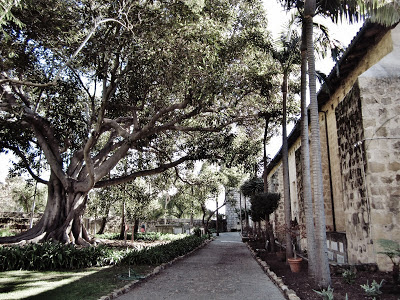
Spanish missionaries were likely amazed by the similarities in geography and climate to their native homeland when they first arrived in California. The architectural style and agricultural crops that had evolved over centuries in Spain were easily grafted onto the California coastal landscape. Even today, a visit to the Mission feels like an instantaneous trip to another place and time. The four of us stepped across the foyer threshold into their Mediterranean world and quietly ambled down the long shady walkway skirting a courtyard garden filled with citrus, palm trees and herbs. An alter of offertory candles flickered warmly in the dim light of an adjoining portico. We admired the craftsmanship evident in the surrounding decorative iron and wood work, and marveled at the ornately painted interior of the church sanctuary. A high arched door led out into the cemetery, where sunlight cast a network of shadows onto the lawn as it passed through the outstretched branches of a gnarled fig tree. I glanced back at the moss covered exterior of the shaded church walls and saw above the doorway a faded arc of skulls and crossbones embossed in the stones.
Across the lawn, the long cool stone walls of the mausoleum interior were lined by polished marble plaques etched with names and titles of important clergy members and prominent citizens who contributed to the success of the mission settlement. I continued strolling the grounds reading the Spanish surnames carved into the tombstones and sarcophagi, each one blending together with the next to form a manifest of faith and devotion. I thought of all the generations of families who have taken comfort from visiting their loved ones in this place and was unsettled by the growing awareness that I was a complete stranger surrounded by two hundred years and many lifetimes worth of memories and experiences that were wholly unknown to me.
And then I saw it. A bronze plaque on the wall in a distant corner of the yard, different from all the rest with its industrial appearance and modern font. I walked over to read what it said and felt my breath catch in my throat.
I knew this story like it was my own. A young woman was accidentally separated from her people during the chaotic evacuation of their island home far off the coast of California. She lived alone on the island for almost two decades learning how to hunt and fish, and to protect herself from predators. A fictional account of her life was published in 1960 by Scott O'Dell, entitled
Island of the Blue Dolphins. From the few shreds of her known history, he wove a story that swept me up in the tragedy and beauty of her solitary existence. She was the idol of my childhood, this strong, resourceful woman who developed the skills to survive in such an unforgiving environment and made peace again and again with her circumstances. Through her experiences I learned that each living creature has to find a way to meet its needs and that every day requires making choices to maintain the delicate balance between connection and conflict. The story ended with her standing at the bow of the ship that would carry her from her island home to the settlement of Santa Barbara.
I had always wondered what it must have been like for her to enter into that entirely new world. The myriad of feelings that were evoked at the sight of strange animals, the taste of new foods, the smiles and laughter of other people around her after so many years of solitude. But also the sadness of learning that none of her tribe had survived to share in her joy, most having died of infectious diseases after being brought to the mainland (I later learned that she succumbed to a similar fate only seven weeks after being rescued). I now marveled at the impact her story must have had upon the people of Santa Barbara, given that they placed this plaque near her humble grave site 75 years later.
We are each the sole owners of our personal memories and experiences, but the resulting stories ultimately belong to the listeners. And in that way her story became ours. Millions of people have taken from the telling what they find most meaningful and have carried that forward with them throughout their lives. And so in some way perhaps we are all essentially writing the same story, one that speaks of a desire to survive and connect through the choices we make over a lifetime.
But, there are also times when I feel that I'm not the writer, but actually the one being written, for I could not have imagined that twenty five years later I would stumble upon this final chapter of her life. The small white marble tombstone was planted firmly in the soil with a fringe of geranium leaves hovering above it. I walked over to it and bowed my head and in that moment became one of the thousands of other souls who have found comfort in this place. I was no longer a stranger. I gave silent thanks for all the ways her life had touched mine and then walked back across the lawn to rejoin my family.