The golden summer season will linger for many more weeks, but in spite of the scorching direct sun and brittle blanket of spent vegetation covering the ground, the days are somehow sweeter this time of year because of the knowledge that they will not last. Long to-do lists and a hurried pace are not compatible with this time of year. Better to make a priority of finding some time to take a dip in the river or rest in a cool patch of shade along its banks. Flowing water demands alignment, which is easy to realize when dangling a foot in the water. Kept toes pointed up or down stream, it’s possible to achieve relative stability and balance, but the moment your foot turns broadside to the current, the river exerts its force. Observing the river, I’m reminded of the peace that comes with slowing down and the awareness that even subdued pressure can realign obstacles.
Wednesday, August 31, 2011
The August River
The river behind our house is a reflection of the seasons. In the fall and winter, its flows fluctuate with the rain and then ebb with the snow. The moisture remains locked up within the frozen high mountains until the warmth of spring returns. Thin ribbons of melting water descend and merge along the length of the mountain until finally they converge, turning the river into a roaring torrent.
The Kaweah River is an altogether different body of water in the late summer season. As the weeks pass, it flows gently through the valley with ever decreasing velocity and volume, creating a serene oasis of cool moisture in the hot, dry foothills. Aside from an unusual pulse of tropical moisture which pushed its way up into the central Sierra for one day at the end of July, the mountains have not seen a drop of precipitation since late May. All but the last remaining patches of stubborn snow have melted in the high Sierra, feeding the river with scant trickles of moisture.
The gradient of the riverbed is more perceptible now that the level is lower, turning torrid rapids into steps and terraces which create a cascading effect. The resulting white froth contrasts sharply with the earth toned rocks obscured just under the surface. Paths of safe passage out into and across the river emerge as the shallow water allows increased visibility of rocks both above and below.
The rounded angles of the boulders create all manner of seats and perches for experiencing the flow of the water. Although cold to the touch at first, it takes only a minute to recognize the temperature as refreshing rather than freezing. Sitting on a boulder above the water, flecks of cool spray periodically jump up to dot my back and legs. Fingers outstretched with palms upstream I feel the buffeting current thread through my fingers.
One of last year’s sycamore leaves long since dried and curled, is dislodged from its limb by the breeze and descends, gently landing onto the surface of the river. Its golden orange color is similar to the patch of rocks in the water below. I watch it bob and shift with the current, navigating the ripples for a while before tipping and plunging under the water. It moves swiftly now with the flowing water in the direction I expect it to go until suddenly it veers sharply with a much stronger current. I follow it just a little further before it gets sucked into an eddy amongst the boulders and I lose sight of it altogether. My gaze returns to the bed of the river and I notice that it is a patchwork of yellow, cream, dark gray, reddish brown and tan interlaced with and covered by clear greenish blue water. Looking upstream the rounded granite boulders are awash in sunshine, suspended in a plain of undulating glass.
The golden summer season will linger for many more weeks, but in spite of the scorching direct sun and brittle blanket of spent vegetation covering the ground, the days are somehow sweeter this time of year because of the knowledge that they will not last. Long to-do lists and a hurried pace are not compatible with this time of year. Better to make a priority of finding some time to take a dip in the river or rest in a cool patch of shade along its banks. Flowing water demands alignment, which is easy to realize when dangling a foot in the water. Kept toes pointed up or down stream, it’s possible to achieve relative stability and balance, but the moment your foot turns broadside to the current, the river exerts its force. Observing the river, I’m reminded of the peace that comes with slowing down and the awareness that even subdued pressure can realign obstacles.
Sunday, July 24, 2011
One Day in Yosemite Valley
The view from above Yosemite Valley as you come out of the Wawona Tunnel is stunning. I mean take your breath away, jaw droppingly stunning. So much so, that all I could do was sit there on the edge of that stone wall and stare at the expanse of trees, shining granite monoliths and ribbon-like waterfalls that appeared before me. It felt like being in a dream, or getting a momentary glimpse of heaven, but each time I blinked it was still there in front my eyes. While it may seem like a dream from a distance, actually being in Yosemite Valley is very much a call to reality. A place this beautiful can’t help but become an international tourist destination, and so it has precariously taken on that role with a mix of grace and strain.

Yosemite Valley is a treat for all the senses. Verdant green meadows carpet the valley floor, making the contrast between the vivid blue sky and stark white granite domes all the more brilliant. Prior to park service development, the leisurely Merced River flowed freely and replenished the lush meadows by occasionally flooding. To reduce the potential for flooding, provide dry ground for camping and decrease mosquito populations, the river was forced into a more predictable pattern of flow and some of the meadows were drained during the first years of park development. Such changes cut off life sustaining water to these valley jewels and in recent decades, attempts have been made to reinstate more natural processes. Meadow drainage tiles have been removed and where possible, the river is being unbound and allowed to flow as it prefers. Boardwalks throughout the valley now intersect this reinvigorated ecosystem, allowing visitors to wander through the sea of green and more closely observe the scattered wildflowers, wetland birds and grazing mammals that live there.
Waterfalls in the springtime roar inescapably throughout the valley, booming and reverberating off the surrounding stone walls, making the undulating white columns of water in the distance all the more palpable. Humid sprays of water amplify the smell of the trees and soil near the falls, giving the air a saturated, fresh smell. Thousands of people wander around the Yosemite Falls area with their eyes cast upward in awe, speaking dozens of different languages, gesturing animatedly as they interpret the maps and educational displays that explain the beauty before them. The trail system around the falls recently underwent a major renovation to allow for better flow of visitors and reduce soil erosion resulting from overuse. The wide, paved trails now allow those visitors, both young and old, with less physical mobility to more safely enjoy the forested, boulder strewn landscape, and inspiring vistas.
By afternoon, the initial rush of excitement has mellowed and if you give into it, a growing sense of peaceful wonder will descend upon you. Sunshine wash
es warmth over every surface, while the cooling alpine breeze chases away discomfort. On the back porch of the historic Ahwahnee Hotel guests and passersby relax, while soaking up the ambiance and grandeur of the park reflected through the structure’s immense stone walls. Providing an interesting juxtaposition between refined civility and the wildness that surrounds it, the hotel was built in 1926 to attract wealthy patrons seeking relaxation and restoration. During WWII park tourist visitation decreased dramatically, but war weary soldiers found still found refuge at the Ahwahnee, which was converted for use as a military retreat. The architects took their design inspiration from the landscape and used locally sourced materials to increase the sense that this place is a part of, rather than an escape from, the natural wonders of valley.
Pensive photographers of all ages raise their cameras to frame shots, while plein air painters place their brushes with care in an attempt to capture a moment that will remind them when they return home, that this surreal place really does exist. Rock climbers laden with coils of rope, their steps accented by the clink of hardware on their belt, scramble over boulder piles leading to the base of El Capitan, Half Dome and dozens of other lesser known climbing walls for the thrill of merging with the geologic wonders of the valley. Thousands of cars squeeze into every available parking space, and in the afternoon fellow tourists on foot and bicycle shake their heads in amazement at the bumper to bumper traffic snaking slowly back home during the afternoon rush hour. If you are looking for solitude, this is not the place for you. If you want to see nature untouched by significant human development, there are plenty of other places in the Sierra Nevada to visit. But if you are looking for natural beauty of the kind rarely seen with such ease, and the communal experience of marveling at that beauty with so many other people from across the country and around the globe, then Yosemite Valley is a place you should experience for yourself.
Yosemite Valley is a treat for all the senses. Verdant green meadows carpet the valley floor, making the contrast between the vivid blue sky and stark white granite domes all the more brilliant. Prior to park service development, the leisurely Merced River flowed freely and replenished the lush meadows by occasionally flooding. To reduce the potential for flooding, provide dry ground for camping and decrease mosquito populations, the river was forced into a more predictable pattern of flow and some of the meadows were drained during the first years of park development. Such changes cut off life sustaining water to these valley jewels and in recent decades, attempts have been made to reinstate more natural processes. Meadow drainage tiles have been removed and where possible, the river is being unbound and allowed to flow as it prefers. Boardwalks throughout the valley now intersect this reinvigorated ecosystem, allowing visitors to wander through the sea of green and more closely observe the scattered wildflowers, wetland birds and grazing mammals that live there.
Waterfalls in the springtime roar inescapably throughout the valley, booming and reverberating off the surrounding stone walls, making the undulating white columns of water in the distance all the more palpable. Humid sprays of water amplify the smell of the trees and soil near the falls, giving the air a saturated, fresh smell. Thousands of people wander around the Yosemite Falls area with their eyes cast upward in awe, speaking dozens of different languages, gesturing animatedly as they interpret the maps and educational displays that explain the beauty before them. The trail system around the falls recently underwent a major renovation to allow for better flow of visitors and reduce soil erosion resulting from overuse. The wide, paved trails now allow those visitors, both young and old, with less physical mobility to more safely enjoy the forested, boulder strewn landscape, and inspiring vistas.
By afternoon, the initial rush of excitement has mellowed and if you give into it, a growing sense of peaceful wonder will descend upon you. Sunshine wash
Friday, May 13, 2011
Changing Seasons
After six months of verdant green, the valley is shifting into the dry golden summer season, so I took a drive this morning to document some of the changes taking place.
The olive groves are in "bloom" right now, which may not appear very spectacular from the highway, but close up the flowers have their own unique beauty.
Winter citrus have been forgotten for the moment, now that we've all eaten our fill and moved on to strawberries and cherries.
But the farmers haven't completely forgotten about them. Spring is a good time to trim up the trees so they're primed for picking again next winter.
Pomegranate bushes happen to have a lot in common with the olive trees. Both are ancient fruits that have been cultivated for thousands of years around the Mediterranean, in a climate very similar to the central valley of California.
Where the olive tree flowers may lack in traditional beauty, the pomegranate blossoms more than make up for it.
Lake Kaweah is on the rise as ample snowpack from the Sierra melts and runs down into the rivers and streams that feed into it. The trees that are slowly being submerged will reappear in the fall as water is used by farmers in the valley for irrigation and the lake level drops. Shortly thereafter, new leaves will appear on the trees as if nothing had ever happened.
Even as everything is drying up, there are still flowers to be found.
This flower's common name happens to be "Farewell to spring". What this says about the discoverer's opinion of the arrival of summer I'm not sure, but it certainly is nice to have such a profusion of beautiful flowers to usher in the season.
I ended my trip at the Sierra Garden Center where I bought a few drought tolerant herbs for the porch. I know from personal experience now that it's going to be a long dry summer, so a little bit of green by the front door will go a long way!
Wednesday, April 27, 2011
A Day in the Life of a Physical Science Technician
I started off working as a biological science technician, running around off trail in the forest helping to collect plant and tree data for the park Fire Ecology program. Little did I know that waiting in the wings was an opportunity to finally use my Bachelor's degree in Meteorology, which I earned thirteen (!) years ago and considered only as a brief step on the path toward my Masters in Education.
I am now officially a Physical Science Technician at Sequoia and Kings Canyon National Park. Sounds like a pretty interesting job, doesn't it? But what does it actually mean? I've gotten that question a fair bit and the short answer is that I now run around the park collecting air, weather and precipitation data for the Air Resources program. The long answer is a bit more or less interesting, depending on how much of a nerd you are.
I mentioned in my very first blog post that Seqouia and Kings Canyon National Parks have some of the worst air quality in the nation, because of their location just east of the San Joaquin Valley, which traps pollution from agricultural practices as well as car exhaust from the Bay Area and the valley. It's a bad combination that leads to significant ozone and particulate matter accumulating in the air. Both are health hazards and obscure visibility by filling the air with a brownish gray haze. I suppose I could now also look at them as a form of job security.
The park has two air monitoring sites - one down near the headquarters at Ash Mountain (elev 1,000 ft) and another up in the Giant Forest (elev 7,500 ft). The Ash Mountain site focuses primarily on monitoring ozone and particulate matter (tiny little specks 2.5-10 microns in diameter that get into your lungs with unpleasant health impacts). Numerous pieces of equipment with different types of filters are running twenty-four hours a day, all year long analyzing the air for ozone, ammonia, particulate matter and other hazardous gases and pollutants. The Giant Forest site looks much more at pollution in the precipitation that falls as rain or snow at elevation. The precipitation samples collected are primarily analyzed for the various components of acid rain, mercury, and now because of the nuclear situation in Japan, radiation.
By far, the best part of my job has been snowshoeing the quarter mile into the Giant Forest site every Tuesday. Sites need to be located in a place where trees don't interfere with the collectors, so in the Giant Forest that meant finding a patch of relatively level ground on the edge of the mountain. I would be quite content doing the most boring job in the world (for a while, anyway), as long as I had this view and got to take this walk through the trees once a week.
View of the valley from the Giant Forest site
Sunlight through the clouds
The day after a snowstorm
Thankfully, this job happens to also involve doing a lot of really interesting things. Collecting precipitation requires a fair amount of vigilance and precision to avoid contaminating the sample. Gathering the data and keeping all the equipment running involves knowing a little about a lot - technology, electronics, basic home repair, common sense, and communication skills, because if anything (including the building that houses all the electronics) breaks it's up to us technicians to fix it with phone support from the various research labs around the country who receive and analyze our data and samples. This week for example, I learned how to replace the diaphragm on an ozone analyzer.
Electronics equipment inside the shelter
Belfort rain gauge (I'll be sad to see this relic go!)
Me cleaning the Mercury Deposition Network precipitation collector
In addition to working for Air Resources, I have also assisted with a database management project for the Environmental Compliance division and the research permit database for the Resource Division. Even the office jobs in the National Park Service are pretty darn interesting. All those years ago at Purdue, I would have never believed that one day I'd be using my degree in this way. It just goes to show that you never know where life is going to take you, but if you're open to the possibilities all kinds of adventures are waiting!
Wednesday, March 30, 2011
The Big Island: Part II
Forty five minutes north of Volcano is Hilo, the capital of the islands. It’s a beautiful sprawling city full of pastel houses and tropical flowers, situated right along the ocean. Much of Hilo was destroyed in a tsunami in 1960, sparing only a few of the downtown buildings, so its history and character seem to be scattered in pockets throughout the city. The famous farmer’s market is open almost every day of the week to sell fruits and vegetables from equatorial regions around the globe. A stroll around downtown reveals occasional glimpses of the "real" Hawai'i where local residents live and work, and tourists just pass through. We stopped by Hilo Shark's Coffee Shop on Waianuenue Avenue a few times to fill up on Kona coffee in the morning and lilikoi lemonade in the afternoon. Another pleasant surprise was the Papahanaumokuakea Marine National Monument Discovery Center, which is a great free visitor center that introduces people to the importance of a marine sanctuary so remote and protected that few people will ever see it.
Continuing north along the winding highway is the Hawai'i of your dreams. Towering green mountains, cascading waterfalls and steep-sided lush valleys wait aro
und every turn. If you have the time, you should definitely check out Akaka Falls State Park for a pleasant hike through a mountain rainforest that leads to a 400 foot waterfall. For the minimal effort it takes to walk the smoothly paved trail, you get an incredible view of one of the most stunning ribbon falls on the island. It's worth the drive. Before you get back on the highway, you might enjoy taking a little stroll around the village of Honomu, which was a thriving mill town back in the early to mid-20th century, when sugar dominated the island economy. This portion of the highway ends at the overlook into Waipi'o Valley, a place that is sacred to native Hawai'ians. The road down into the valley is only accessible by 4-wheel drive vehicles, and at an average grade of 25%, if it were actually classified as a road it would be one of the steepest in the world.
With a few hours to spare before our flight and not enough energy to sightsee in the heat, what else was there to do, but crash the bar at the Four Seasons north of Kona? While the rest of the coast was whipped into a frenzy by strong winds, the beach at the Four Seasons was blissfully calm. We walked along the beach watching the rolling turquoise waves and stalked some of the non-native flightless fowl begging for handouts around the bar area, before settling down into plush deck chairs to have ridiculously over priced drinks and appetizers. After a busy four days traveling all over the island, the chance to sit in a comfortable chair, sip a cold glass of white wine, and watch the sun set over the Pacific Ocean was worth every penny.
Tuesday, March 22, 2011
Death Valley Adventures
In spite of her desire for opulence and comfort, Bessilyn fell in love with the simplicity of the desert once writing that, "Something about the clear desert atmosphere seems to make the moonlight brighter than anywhere else in the world, and to glorify it. And the great mountains rise in the splendor of it all. Moonlight in the Desert! You may have cities and electric lights, movies, dancing parties, and surging crowds; but for a thrill, an emotion, a sense of peace, and a confidence in a God who cares, give me moonlight in the Desert."
Here are a few other photographic memories from our trip:
Sunrise at Mesquite Flats sand dunes
Devil's Golf Course
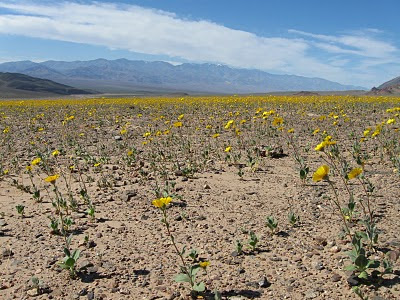
Desert gold off Hwy 178 in mid-March
Monday, February 14, 2011
Marble Falls Early Spring Hike
Early spring has arrived in the foothills! The daffodils are up, all the California buckeye have leafed out, and the other trees and shrubs are in various stages of bud and bloom. Even though it never gets cold enough here for me to have any real complaints, it hasn't actually felt like spring until this past weekend. A dry cold front moved through earlier in the week, sweeping the stagnant haze out of the valley and temperatures finally cracked the 70 degree mark, making it a warm and blissfully clear Saturday to go for a hike.
The last time we hiked Marble Falls was in June - the very first hike we went on after moving here. I was curious to see how different the trail would look in the very early stages of spring. There are no wildflowers in bloom yet, but still a variety of interesting signs of plant life to be seen.
The trail switchbacks up the side of the mountain, following the stream-eroded topography, which means you weave in and out of exposed, hot dry chaparral and cool, damp green canyons. There are so many contrasts between these two habitats, which exist side-by-side: hot and cool, dry and damp, bare rock and moss, dust and streams.
Once you get higher up the mountain, you round a corner and finally see the entrance to the deepest part of Marble Canyon. The size, number and variety of trees increases with the cooler temperatures and greater moisture at higher elevation. The angle of the mountainside causes many of the trees to arch with the pull of gravity as they reach for sunlight. California bay laurel trees also become more plentiful and their leaves and flowers fill the air with a fresh sweet smell that makes you wish you could bottle up to take with you after you leave. The sound of the falls grows louder as you get closer. As my husband commented, hiking this trail really is an experience that makes all your senses ridiculously happy.
By the time you reach the falls you are walking on a floor of undulating gray and white banded marble, resulting from metamorphosed limestone during the formation of the mountains, and smoothed by countless years of flowing water. The contrast between the white rock and the shadow cast by the canyon wall is so great that it's difficult to take good pictures of the falls themselves. That being said, it's still a great place to take interesting pictures, and especially to sit and enjoy the powerful rush of water.
We hope to hike this trail again sometime in April to see how it evolves as spring continues. I'll be sure to post pictures of that hike so you can see the changes! If you'd like to see more pictures from this hike, you can view them here.
Since my last post, I've started working for the park as a Physical Science Technician doing data collection and instrument maintenance for the Air Resources program at the park. Once I take a few more photos, I'll be sure to post about that experience in more detail. I also owe you two more posts on our vacation to Hawai'i, which I'm sure I'll be happy to revisit as the rain and cold return to Three Rivers this week.
Subscribe to:
Posts (Atom)