Showing posts with label Sierra Nevada. Show all posts

Friday, February 28, 2014

Come Rain or Shine

We've been famously short on moisture here in California recently, with 2013 now having the distinction of being the driest year on record. According to tree ring comparisons, climatologists say it may also have been the driest year in five centuries. But no amount of statistical analysis can make a dent in the rainfall deficit.

The drought makes for compelling headlines to accompany shocking images of vastly shrunken water reservoirs and dire predictions of produce price spikes and shortages. Farmers are planting 200,000 less acres this season and in an effort to prevent disease and insect infestation, tens of thousands of mature drought-stressed almond trees are being ripped out of the ground. But while these stories generate sympathy and discussion, they too cannot produce any rain. No amount of knowledge, research or prediction will - all we can do is wait.

On the clear days, I sit outside on the deck in shirtsleeves soaking up the midday sun with a chilled glass of wine and a salad. The weather is perfect for tackling yard work - warm with just a hint of breeze. We rake up dried leaves and cut down dead limbs, hauling everything to a burn pile at the back of the property. I mow the lush green lower part of the yard, where what little rain we've had tends to settle. The scent of narcissus and daffodils rise up around me as I wage my never-ending war against the weed sprouts in the flower beds.


On the infrequent rainy days, I huddle up on the couch under a fleece blanket in my warmest pajamas with a bowl of hot chili. Low gray clouds hide the mountain peaks out the living room window as droplets pelt the skylight above my head. I catch up on my reading while the cat naps in my lap and when the rain really starts coming down I pause to admire the sheer white curtains of moisture drifting across a backdrop of dark tree trunks in the neighbor’s yard. The fire in the wood stove burns all day long as I feed it pieces of the oak trees we cut down last spring.


They say we will not get enough rain the rest of this season to make up for the past few months of sun. Towns around the state need to ration water and so people should expect fewer showers, parched gardens and dirtier cars. No one dares to talk about wildfire season yet. Instead we talk about forecasts and miracles, hoping each new inch that falls will take us closer to that mythical yearly average.

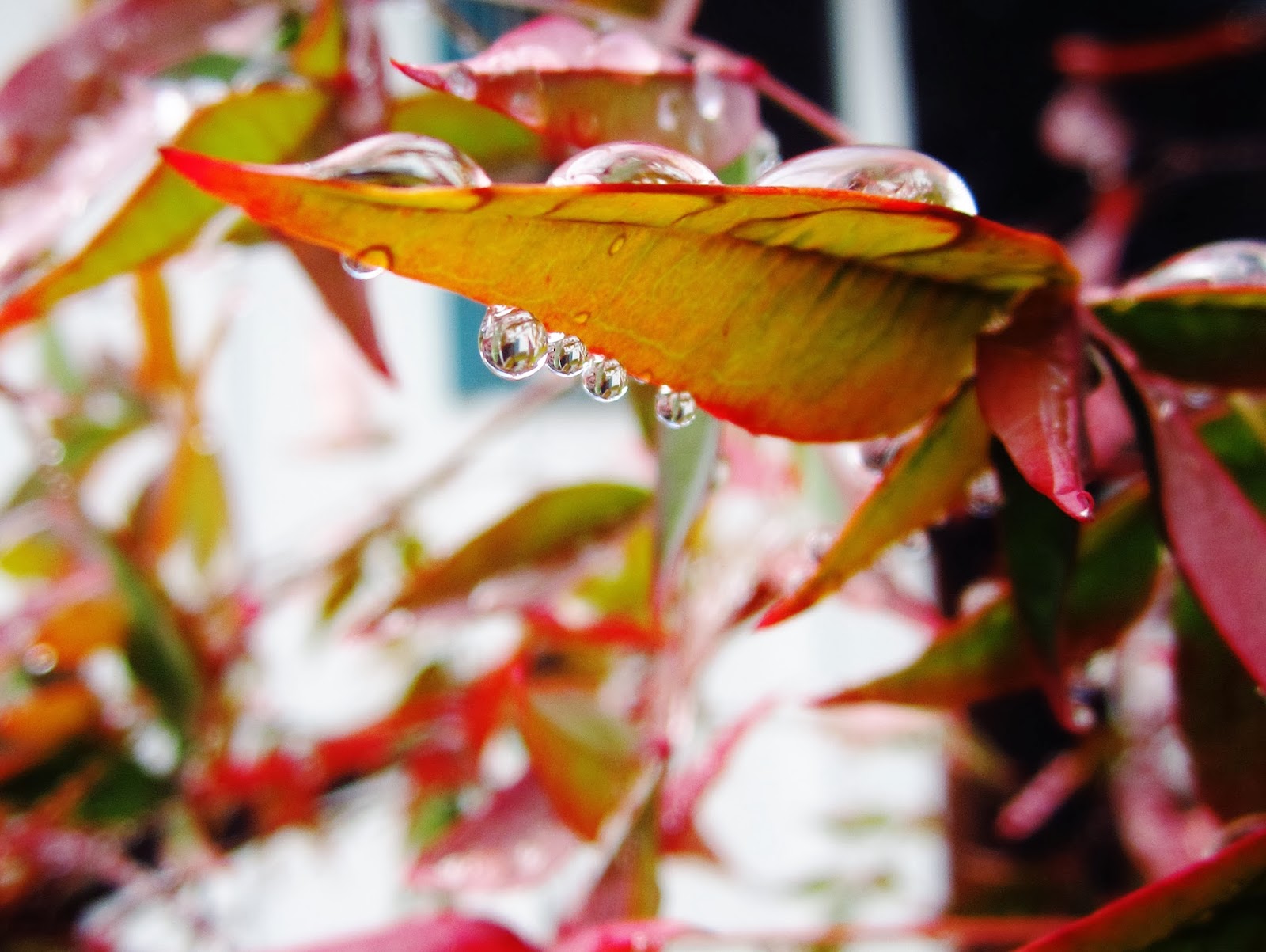
In spite of all the worries and fears, I find myself appreciating more these days. The hot sun on the back of my neck in the middle of winter. The daffodils that sprouted and bloomed despite the lack of moisture. But most especially, those glorious days when the clouds gather and darken overhead, releasing their precious moisture. I breathe in the smell of damp earth as I walk around the yard with my camera, trying to capture the ephemeral beauty of the fallen rain.


Monday, September 30, 2013

One September Day

Autumn arrived on the afternoon breeze.

I heard it approach as it threaded
Through the tops of the dusky gray pines
Lacing between their densely needled boughs
With the lilting ebb and flow of a hushed roar.

It softly touched my cheek before slipping
Down the length of my bare arms
Taking with it any trace of accumulated heat and dust
As a coolness spread across my skin.

The scent of the sea was carried in its gusts which swept
From the coast and across a wide valley to these hills
Conjuring memories of damp salt tinged days
Along the cloudy shores of Monterey.

I watched it glide through the weary oaks who sighed
As they released their pale summer scorched leaves
Lofting them into the reinvigorated air
To celebrate the moment the world changed.


Monday, September 3, 2012

In Mary Austin Country

I first heard of Mary Austin when searching for a new book to read. While perusing a list that the San Francisco Chronicle put out a few years ago ranking the 100 best nonfiction books about the American West, I noticed her book, The Land of Little Rain, at the very top. A laundry list of thoughts began to pile up in my head - I had never heard of her; I had never heard of this book; It was written in 1903 (by a woman roaming the high desert on her own, no less); How did this book make its way to the top of the list? As it turns out, this slight, unassuming collection of short essays opened my eyes to a whole new way of looking at the world.

Austin wrote about the West through her own direct experiences and observations. She reflected for a sentence, a paragraph or a whole chapter on subjects as small as an insect or as expansive as the sky. It was all connected in her mind, and therefore worthy of the time it took to explain how. She became a student of sheepherders and Native Americans - two groups who were marginalized and disdained by society at the turn of the last century. Her careful, compassionate observations of their daily life now provide us with a window into their world and an opportunity to reflect on our own perceptions and prejudices.

While on a road trip on the east side of the Sierra last weekend, I passed through the little town of Independence and took some time to visit the place Mary called home while writing The Land of Little Rain. At the local history museum I learned about resident Native American tribes, the Manzanar Internment Camp for Japanese-Americans during WWII, area mining claims, the Owens Valley water battle with Los Angeles, and details about many important local figures. Regarding Mary Austin, they had arranged a small glass case with original copies of a few of her books, a single photograph and a brief biography. I left the museum somewhat disappointed by this very humble tribute to a woman who has so illuminated our cultural and ecological understanding of the West. On the way out of town I passed by her home. A small historical marker stands out front with little information provided beyond a short, albeit compelling, quote. The 'no trespassing' signs around the property make it clear that this home serves as a monument only and not a museum. 

As I walked back to my car, I happened to glance to my right and noticed the flat wide street in front of her house heading due west out of town and straight up into the mountains. I heard her words in my head, "All streets of the mountains lead to the citadel; steep or slow they go up to the core of the hills." I realized that although her contributions may be assembled in a shadow box, summarized in a paragraph, or analyzed by professors in a classroom, Mary's real tribute is written across the vast landscape of the Eastern Sierra. She is a kindred spirit to those who wish to view the world with an unbounded sense of curiosity and wonder. How could such a spirit be contained inside four walls? 

And so here is my tribute to Mary...


"There is a Paiute proverb to the effect that no man should attempt the country east of the Sierras until he has learned to sleep in the shade of his arrows. This is a picturesque way of saying that he must be able to reduce his wants to the limit of necessity. Those who have been able to do so, and have trusted the land to repay them, have discovered that the measure is over-full. A man may not find wealth there, nor too much of food even, but he often finds himself, which is much more important."
-Mary Austin


"The shape of a new mountain is roughly pyramidal, running out into long shark-finned ridges that interfere and merge into other thunder-splintered sierras. You get the saw-tooth effect from a distance, but the near-by granite bulk glitters with the terrible keen polish of old glacial ages...When those glossy domes swim into the alpenglow, wet after rain, you conceive how long and imperturbable are the purposes of God."
-The Streets of the Mountain


"The lake is the eye of the mountain, jade green, placid, unwinking, also unfathomable. Whatever goes on under the high and stony brows is guessed at." 
- Water Borders


"The arrow-maker had a stiff knee from a wound in a long-gone battle, and for that reason he sat in the shade of his wickiup, and chipped arrow points from flakes of obsidian that the young men brought him from Togobah, fitting them to shafts of reeds from the river marsh...They drove bargains with him for arrows for their own hunting, or for the sake of the stories he could tell. For an armful of reeds he would make three arrows, and for a double armful he would tell tales."
- Mahala Joe


"Sometimes she plaited willows for the coarser kinds of basket-work, or, in hot noonings while the flock dozed, worked herself collars and necklaces of white and red and turquoise-colored beads, and other times sat dreaming on the sand." 
- The Coyote-Spirit and the Weaving Woman


"It is difficult to come into intimate relations with appropriated waters; like very busy people they have no time to reveal themselves. One needs to have known an irrigating ditch when it was a brook, and to have lived by it, to mark the morning and evening tone of its crooning, rising and falling to the excess of snow water; to have watched far across the valley, south to the Eclipse and north to the Twisted Dyke, the shining wall of the village water gate; to see still blue herons stalking the little glinting weirs across the field."
- Other Water Borders


"None other than this long brown land lays such a hold on the affections. The rainbow hills, the tender bluish mists, the luminous radiance of the spring, have the lotus charm. They trick the sense of time, so that once inhabiting there you always mean to go away without quite realizing that you have not done it." 
- The Land of Little Rain


"But if ever you come beyond the borders as far as the town that lies in a hill dimple at the foot of Kearsarge, never leave it until you have knocked at the door of the brown house under the willow-tree at the end of the village street, and there you shall have such news of the land, of its trails and what is astir in them, as one lover of it can give to another." 
- Quote on the historic marker outside her former home